Easter 7 - Year B
John 15:9-17
“'When I use a word,’ Humpty Dumpty said in rather a scornful tone, ‘it means just what I choose it to mean — neither more nor less'."
Words can mean different things when we use them in different contexts. We love caramel, we love our national anthem, we love our dog Rex, we love the way our small children mispronounce words, we know our parents love us even when we're in a pinch and we find ourselves reassured by the promise of God's love demonstrated and expressed in the Cross of Christ. Each one of these uses differs from the other. Some are shown to be real because we sense a sentiment within ourselves which may or may not pass quickly when we grow out of loving something. Our children grow into surly teenagers. We wish they'd learn to pronounce things properly if they hope to get through a job interview.
The Greek language has different words for love - more than we do in English. They avoid some of the ambiguity and confusion by having different words for erotic love, love between friends, simple affection and the self-giving love which is Agape. C.S. Lewis in his book "The Four Loves" describes these different definitions along a line stretching from "need love" at one end of the spectrum to "gift love" on the other. Love can feed and build up the lover or it can feed and build up the beloved. Which one is which is important to the children we raise, the man or woman we are married to, the community we serve or to the world which waits for the Church's offering of care and compassion. Do they serve us or do we serve them? Confusion here can be dreadful. The vocation of a parish church within its community can be lost, the fabric of a marriage torn apart or children poorly served by parents when the beloved discovers that he or she was poorly loved and the lover simply replies that he or she could not generate enough feeling or sentiment within themselves.
We learn to love. We have not all been equally loved in the course of our lives. Some of us will need to unlearn early experiences. How we love in our adolescence or early adulthood will be tested and reformulated as we grow older. Love is tested by the trials of life and above all by the need to make decisions. The difficult person, the growing child, the normal human to whom we are married, the members of the Christian community into whose presence we have been thrown by our membership in the same parish: all these will require decisions and actions which stem from our will and not merely from the reservoir of sentiment we happen to have at hand at any given moment. Those around us will grow strong when we choose to love.
Wednesday, May 13, 2015
Saturday, May 02, 2015
Easter 3 - Year B
Luke 24:13-35
Luke describes events on the road to Emmaus, near Jerusalem, where Jesus broke
bread in the midst of two disciples and opened their minds by his exposition of
the Scriptures. The downcast disciples were heartened by the encounter and went
on their way much improved. A clergy-person might feel tempted to own this
scripture passage.
Word and Sacrament? In the space of an hour or so? It's about us, innit?
Don't we strive to be this sort of "point on the journey" for our
parishioners? Wouldn't it be great if, on next year's Annual Parochial Return,
I was able to report that most our our membership had gone from "Wandering
Uncertainty and Deep Perplexity" (line 6) to "Blessed Assurance,
Expectation and Commitment to Living the Resurrection Life" (line 8)? Alas,
I do not think Saint Luke is plotting out the shape of a perfect church service
or a parish's program year. Yet there is an important point to glean herein.
Jesus is inordinately interested in what the disciples are already talking
about. He asks them about it.:
"What are you discussing with each other while you walk along?"
He is more interested in them than we are, oftentimes, in our own people. Where did we develop the bad habit of treating the visitor, the new member or the "passer-through" as a bank slate - a tabula rasa, if you will - upon which we impose the indisputable goodness of the creeds, the Mass, John 3:16, the happy life of our parish, bells, hymns, incense or the compelling brown eyes of the Rector?
A shining light of revelation which dismisses human concerns, hopes, griefs, joys, errors and aspirations and takes them off the table with one sweep of the arm is a truly limited affair in the Bible. You don't find much of that. Most of the encounters God has with people are genuine conversations. We already know that the years of struggle or inner turmoil which precede our own healthy forward steps are not negated when we do, in fact, step forward. They are a part of the process. We may be better off afterwards but we are still the struggling person God met when he or she was still struggling.
He reasoned with us over time. He met us on the road. This is evidence of love and it made the next part possible.
Posted by
Raspberry Rabbit
at
5/02/2015
0
comments
Labels: 500 words on a reading
Friday, May 01, 2015
John 15:1-8
Posted by
Raspberry Rabbit
at
5/01/2015
0
comments
Labels: 500 words on a reading
Thursday, April 23, 2015
Easter 4 - Year B
John 10:11-18
Worry is a relative thing. A few of us should worry more. Many of us worry far too much. We worry about things which are theoretically possible but will never happen. We worry about things which worry itself will not change. We worry about things which can be fixed but worrying does not, in and of itself, provide us with the means or motivation to make those changes. Anxiety becomes a free-floating state of mind - a way of life rather than a tool to keep us safe. Useless and wasteful, it shortens our lives and robs the world of its colour.
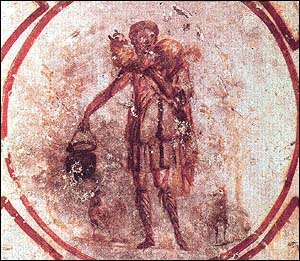
Do you believe that we have a Saviour, an Advocate and a Shepherd? We say the words and we sing the hymns (the above is from 2 Timothy 1:12). In the best of all possible worlds those words would sink down into our souls and condition our response to both real and imaginary threats. What is in the way? Perhaps we were taught to fear by others and are carrying the baton in our generation which our parents passed to us. Perhaps we were improperly shepherded or nurtured by grownups when we were small and learned to fear anything in the world which was beyond our immediate control. Discovering whose voice it is which we hear on the tape-loop in our heads when we fret is something which might well repay the effort.
Jesus does not tell us that the world will always be a safe place. He does tell us however that he knows us. And that we can know him. This is somehow enough. The strength of that loving bond will be sufficient to sustain us in good times and in bad. The gift of God to the world was, is and remains the Person of Christ in whom there is nurture, protection and ultimate safety. Be persuaded of that love. Invest - actively and intentionally - in that relationship.
Posted by
Raspberry Rabbit
at
4/23/2015
0
comments
Labels: 500 words on a reading
Thursday, February 26, 2015
Romans 4:13-25
So why not switch ropes? God never showed Abraham a mirror in order to encourage him that, if he eats all his veg, he might locate a bit of life left in that old frame of his - one more lap around the track, if you like. God pointed Abraham beyond himself - to the innumerable stars in the sky and the grains of sand on the beach. "So shall your descendants be", says God. I will make it so. And "Abraham believed God". The second rope.
Posted by
Raspberry Rabbit
at
2/26/2015
0
comments
Labels: 500 words on a reading
Prospect
Matthew 17:1-9
Squint and you won't look so fat in the mirror. Take your specs off and you could obscure your vision still further. The world might look even better. Or follow the old platitude and take a second gander at your familiar cloud. Find its silver lining. Force yourself. Deep down, though, you know that it's a normal exercise in self-deception. We do it all the time. We're working hard to cover up reality. We hide much. We reveal nothing.
In this Sunday's Gospel reading, Jesus takes Peter, James and John with him to a high mountain (the story appears in all first three Gospels). In their presence Jesus is "transfigured". Matthew and Mark use the passive verb "was metamorphosed" while Luke chooses to describe the process thus: "...the fashion of his countenance was altered". Jesus shines. His clothing becomes bright. Two characters from Israel's history - Moses and Elijah - suddenly appear at his side. A voice speaks from heaven. The disciples are afraid and do not understand. They babble or, at least, Peter babbles.
Recognizing that the disciples do not have the words to describe what they have seen, Jesus tells them to keep their mouths shut: "Tell no one about the vision until after the Son of Man has been raised from the dead".
Unlike the normal impulse to prettify a shabby situation, this vision strikes the disciples out of the blue. It is one which I believe has been better painted by artists, over the years, than it has been retold by preachers. It is what it is: a hint or a first installment of something that is to come. For the three disciples it is precisely what they will know and preach with clarity after Easter. It is what St Paul will one day write about to his congregations. For Peter, James and John that day, God opens the door just a crack. They catch a glimpse of the full picture: Jesus the light to the world who unites the present (and future) world of his followers with the mighty and saving acts of God in the history of Israel.
Willful self-deception closes a door.
Unbidden mystery forces it open.
"This is my Son", God says, "Listen to him!"
Posted by
Raspberry Rabbit
at
2/26/2015
0
comments
Friday, February 20, 2015
Mark 1:9-15
Posted by
Raspberry Rabbit
at
2/20/2015
0
comments
Labels: 500 words on a reading
Friday, February 13, 2015
Mark 9:2-9
Posted by
Raspberry Rabbit
at
2/13/2015
0
comments
Labels: 500 words on a reading
Friday, February 06, 2015
Prospect
Matthew 5:13-20
As with many of the parables and pronouncements of Jesus he takes something well-known and gives it a twist. That salt and light are necessary and good is the truism in this Sunday's passage from Matthew's Gospel. Of course salt and light are necessary: Without a healthy pinch of salt all the flavours in the dish are understressed and hidden. Without light the colours and contours of the room are hidden and one would be excused for having missed them entirely. The absence of salt and light renders the world unremarkable.
The twist in this passage is Jesus' claim that his newly gathered band of followers is that salt and light for the world. The Sermon describing the blessedness of his followers and their vocation in the world appears almost immediately following the call of the disciples - when they bear very little with them to the hillside. They were fishermen or householders once - once upon a time they were far more implanted in structures of human community than they are now. Now they are (merely) followers - part of the first community Jesus has built around himself. In Matthew's version the followers' effect on the world is described using the dual metaphors of salt and light.
The great turns in Salvation History usually involve applications of human freedom at the impulse of God's word. As proud as we may be of having held to a steady course for the sake of our families and our treasured networks it will be those curious and sometimes costly about-turns which we find to be necessary or right or which we feel called to undertake in the midst of life which will give our life's story its ultimate sense. Our example of discipleship (and not just rigorous consistency) points the world to the value which must be discovered like a treasure in a field and not merely chipped from a quarry in a daily grind. Our children could be concerned - let them be concerned! Our abandoned co-workers might well cock their heads and wonder at it.
Every day need not be the same. Life can taste and look that good.
Posted by
Raspberry Rabbit
at
2/06/2015
0
comments
Labels: 500 words on a reading
Thursday, February 05, 2015
Isaiah 40:21-31
Have you been waiting long?
Posted by
Raspberry Rabbit
at
2/05/2015
0
comments
Labels: 500 words on a reading
Friday, January 30, 2015
Prospect
Matthew 5:1-12
You don't get rich by being faithful. We've all known faithful people who remained folks of modest means and frequent sorrows throughout their lives. What does Jesus mean, then, in the Sermon on the Mount when he says that the poor (Luke's version) or the poor in spirit (Matthew's version) are "blessed"?
Jesus must have meant something other than "rich". He speaks to a humble and disenfranchised crowd who know that their economic fortunes are limited and vulnerable to catastrophic change. In the Sermon on the Mount he goes nowhere towards promising them that the blessedness will translate into monthly income, houses or possessions. Jesus intends these words about blessedness as a play on words and a paradox. He, himself, is living as a guest in Peter's house in Capernaum. His first disciples, rather than increasing their family incomes, are all walking away from their livelihoods in order to follow Jesus.
We might be driven to the internet or to to our Greek dictionary to find out what the word "blessed" (makarios) meant when Luke and Matthew used it. With its root makar meaning "extended" or lengthened or increased, it would appear that the blessed ones, the makarioi, are going to have some bigness about them and something - if not earthly riches - in abundance. Lots of it - the full measure, pressed down and overflowing!
But what is it? What is like riches - but not? Or like the earthly harvest of fish, grain and miscellaneous revenue but attractive enough to prompt capable people away from these things? Why do they follow and why do they believe? Do we not marvel a bit at their freedom?
There is no question that the words of Jesus, then and now, access a deep hunger that earthly enterprise with its uncertain and transient blessings will not satisfy. Faith becomes the chief asset in this new economy. The bottom line is blessing - satisfaction that following Jesus has assured our participation in the big world of the Kingdom, the discovery that other followers have become our family and joy that we have discovered a purpose in life beyond carving out an abundant niche for ourselves.
The parables and sayings which follow in the Gospels will further unpack this to a group of new disciples who, from time to time, will waver in their newfound faith.
We shall be attentive!
Posted by
Raspberry Rabbit
at
1/30/2015
0
comments
Labels: 500 words on a reading
Wednesday, January 14, 2015
Luke 1:26-38
Posted by
Raspberry Rabbit
at
1/14/2015
0
comments
Labels: 500 words on a reading
Thursday, November 06, 2014
"...those who were ready went in with him to the marriage feast; and the door was shut."
A number of Jesus stories concern things which go wrong at weddings. Guests don’t show up when invited. Folks show up badly dressed and are unceremoniously tossed out of the banquet hall. The drinks run out. In this Sunday’s reading a group of attendant young women was given the job of welcoming the bridegroom back to his house with his new bride through a gauntlet of lighted lamps. He was late back from the bride's family home where the marriage contract had been signed. The girls had all fallen asleep and, when they were roused, half of them were unable to fulfill their appointed task because they had forgotten the fuel for their lamps. Take a seasoned clergyman out for supper someday. Ask him about strange things which occur at weddings. You’ll be entertained.
This Sunday’s parable leaves us none the wiser about wedding services in the ancient world. The point is elsewhere. Chapter 24 and 25 of Matthew’s gospel are all about events and reckonings which may take us by surprise. They shouldn’t, though, because we ought to have been expecting them. It looked like a nice morning but by this afternoon the gale was howling and our roof blew off. We thought it was just an ordinary day but then the telephone rang. Everything changed immediately. All the jobs we were putting off were suddenly required of us - now - this instant. Come to my office with the promised presentation prepared. Show us your accounts and how they balance. Line up your children and have them recite the Nicene Creed. Feed the dozen people who have just now landed on your doorstep. You did, after all, say “Drop by any time”.
Readiness is a virtue in the apocalyptic world of Matthew 24 and 25. Would you prefer to live in a world where the faith of individuals and communities is an option? Are you only aware of vague promises about, some day, changing your hardness of heart towards the people around you? Have you taken a gamble that, eventually, you will try and figure out what the nature of your attachment to Jesus is?
Do understand that this same Jesus, in a story framed by Matthew the Apostle, is putting the wind up you and calling into question the time you imagine you have. How you live now tells the story of who you are now. These things are all crucially important. Don’t let the clock tick on. Don't let the door shut.
Posted by
Raspberry Rabbit
at
11/06/2014
0
comments
Labels: 500 words on a reading
Tuesday, October 14, 2014
Prospect
Exodus 33:12-23
It's been a tough trek. Stress, anger and uncertainty have been the order of the day. Exhausted, Moses checks in with God. Is it alright? ask Moses. Are we still your people? Even with the incident with the golden calf and the nonstop discord on the people's part? Will you continue to lead us God? Moses receives affirmative answers to all these questions. The whole reading is a bit curious. It even appears that God is tired of being angry. Moses proceeds, at this point, to ask a question of his own - one which is important to him alone and seems almost irrelevant to his role as the leader of this sorry band of Hebrews in the Sinai desert:
I want to see you God. "Show me your glory"The earlier conversation with God is something with which we are all familiar: We lay before God our faults, we lay before him our needs, we struggle to review our situation in such a way (or to change our situation in such a manner) that we can be assured that things are alright. We have some hope for the future. We restore a balance. That is frequently enough. Moses goes further, though. "Show me your glory" he asks.
Is this relevant?
Yes - the knowledge of God is relevant, the enjoyment of God's presence is relevant. It may be the most relevant thing. The Presbyterian/Reformed catechism states that "Man's chief end is to glorify God and enjoy him forever." Our relationships have a way of becoming identified with the responsibilities attached to them. To the man or woman we love, and whose presence we enjoy, we are also husband and wife and bear certain duties and obligations. The children we delight in also need shoes and transport. They grumble in the back seat and argue with their sisters. We rejoice in Christian worship and the presence of our brothers and sisters in the Church but somebody on the vestry needs to tackle the knotty problem of scheduling events and ironing out the finances of the parish.
We might find ourselves, as Moses does in this reading, relatively exhausted by duty and desiring the mere presence of the one we love. That, I think, would be a sign of health. God grants Moses his desire. He places Moses in a cleft in the rock and passes by. Moses gets the glimpse of God's glory that he needs.
We need that cleft in the rock. Where will you find yours? It may need to be consciously searched out. If you look for it you will find it. It is a place where we are simply who we are in the presence of the one we love - that man or woman, those children - that first love. We begin by declaring our hunger for it and reminding ourselves that our chief delight is the presence of the one we love. While such love will always contain the structures of duty and obligation we have a right to feel the heat of the fire and to thrill in the sound of the voice. It is completely proper to desire such things.
Moses does well to ask. There's more to life than a slog through the wilderness.
Posted by
Raspberry Rabbit
at
10/14/2014
0
comments
Labels: 500 words on a reading
Wednesday, October 08, 2014
Posted by
Raspberry Rabbit
at
10/08/2014
0
comments
Labels: 500 words on a reading
Wednesday, October 01, 2014
The vineyard is fruitful and God is at work there. Vines grow even in the poor and rocky soil - grapes are produced which would be a source of blessing for the surrounding community. In the parable, though, the controversy centers around this fact: The vineyard is both the master’s vineyard with a particular purpose within the master’s mind and also the place where the tenant farmers live - where they raise their children and put their nameplate on the door.
It is mine - says the Master.It is ours - say the tenants.
Posted by
Raspberry Rabbit
at
10/01/2014
0
comments
Labels: 500 words on a reading
Friday, September 26, 2014
Proper 21 - Pentecost 16
Year A
Matthew 21:28-32
In Sunday's Gospel reading Jesus explains that the tax collectors and the prostitutes are getting into heaven before the Pharisees and the Scribes because they have seen the light and changed their ways.
Posted by
Raspberry Rabbit
at
9/26/2014
0
comments
Labels: 500 words on a reading
Wednesday, September 17, 2014
Pentecost 16 Exodus 16:2-15
The Old Testament readings from the Book of Exodus have been quite fruitful these last three weeks. This week’s reading is no exception. The topic is the anxiety which the Israelites feel in the midst of their wanderings through the desert after a dramatic escape from Egypt. Moses and Aaron are feeling the full weight of the individual and familial angst. The task of leadership becomes difficult as hitherto forbidden questions begin to be asked: Was the life we led as slaves back in Egypt really that bad? Was there not bread back home - occasionally even meat in the pot? We might die out here in the desert. It could all go so wrong.
Posted by
Raspberry Rabbit
at
9/17/2014
0
comments
Labels: 500 words on a reading
Friday, September 05, 2014
Prospect
Ezekiel 33:7-11
There was a choice of Old Testament readings this Sunday and the Rector’s eye fell upon Ezekiel 33 as somehow being “just the ticket”. Oh, here we go: wickedness, sin and death. Clergy are a jolly lot, aren’t they? As the 10:30 AM services at the Royat chapel kick off again for the year might we suspect that a new era of fiery preaching (in a tasteful Episcopalian mode bien sur ) is about to begin?
Know this, first of all: The passage relates to a growing self-awareness on the part of the people that all is not well with them. The preaching of the prophet in troubled times has hit a nerve. They say “Our transgressions and our sins weigh upon us, and we waste away because of them; how then can we live?”
They have come to believe there is no remedy for what ails them.
God’s question to them - through the words of the prophet Ezekiel - is this: Why should you die in your sins? It is not necessary. It is not the pleasure of God that men and women should find no remedy.
So it usually goes with the people of Israel in their lower moments. Life is Egypt as slaves, life under the occupation of foreign oppressors, life lived with a corrupted religious life or under the leadership of violent and corrupt Kings - it’s just the way it is. It’s their lot in life. They’ve made their beds somewhere along the way and now need to lie in them. Bring on, then, successive and eternal chapters of the same damned thing.
And the question - “why” - well, it’s a child’s question, isn’t it? Our kids ask it from the back seat of the car with the innocence of believing that one can always redraw a picture if it’s no good.
Still, it’s a tantalizing question. The question that God asks the people through the prophet Ezekiel might even nag us. What is it that ties us down to weakness, failure, sin and unhappiness? Do we not know of a better way?
“Why’ does it need to be the way it is?
Posted by
Raspberry Rabbit
at
9/05/2014
0
comments
Labels: 500 words on a reading
Friday, August 29, 2014
Lent 3
Exodus 3:1-15
Matthew 16:21-28
Moses got distracted.

It might have been recommendable to keep to the path. With a comfortable marriage and a looming
inheritance all Moses needed to do, to ensure a comfortable future for himself, was to put one foot in front of the other. He could have meandered into late middle age and a respectable dotage.
A bush suddenly leaps into flame on a distant horizon and the twinkling catches Moses' eye. He utters the fatal words:
"I will turn aside and see this great sight, why the bush is not burnt".
Significantly, I believe, God waits until he sees Moses turn aside from following his father-in-law's sheep. When he sees him do this, God speaks to him, and the story of the Exodus begins.
We have all taken our eye off the ball at some time. We might reproach ourselves for a misspent youth or a series of bad decisions as young adults. When we were small and we looked out the window we had a blackboard brush thrown at us by a teacher. Somebody might have insisted that we pare down our social, cultural or sports activities in order to concentrate on the three subjects most likely to give us the greatest purchase on a stable future.
When the local minister joined the school for weekly Assembly there might have been a truly remarkable agreement between him and the Head Teacher or school Principal that regular habits of work and stable progress towards a goal were "just the ticket". Funny how that works.
We will talk this Sunday about risk and uncertainty. Both the first reading from Exodus and the Gospel reading from Matthew's Gospel throw a wrench into the idea of the stable life gained by increments being the be-all and end-all. There are things worth wrenching your life apart for. Moses heads off to talk to God. He loses the life he has built for himself in Midian. Jesus declares his intention to leave the Galilee and to undergo great suffering in Jerusalem. The reaction of his disciples is conservative and predictable: Heavens no - stay safe and consolidate what we have begun here. His words to them extend beyond them to us:
"...whoever would save his life will lose it, and whoever loses his life for my sake will find it"
I look forward to speaking with you about this on Sunday. We'll see you there.
Posted by
Raspberry Rabbit
at
8/29/2014
0
comments
Labels: 500 words on a reading